

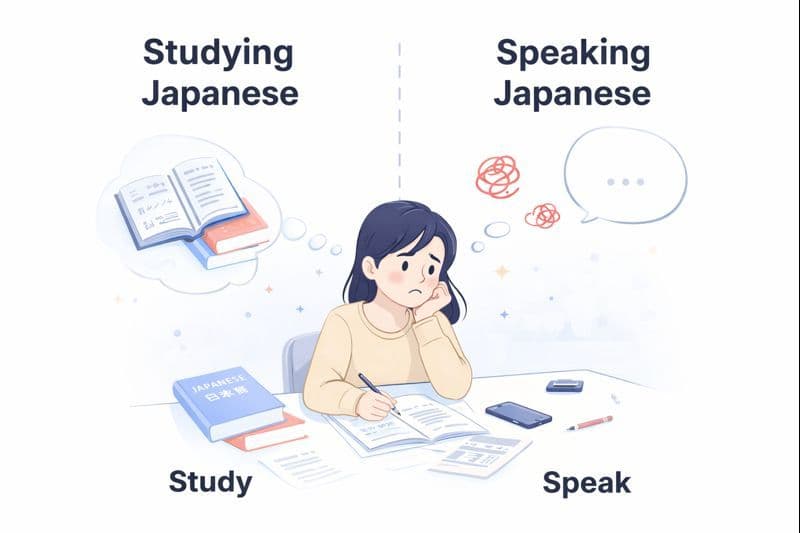
Why Studying Japanese Doesn’t Make You Speak Japanese

Many people study Japanese for years.
They memorize vocabulary.
They learn grammar rules.
Some even pass JLPT N2 or N1.
And yet, when it’s time to actually speak, they freeze.
If this sounds familiar, you’re not bad at languages—and you’re definitely not alone.
The Gap Nobody Talks About

Many learners can study Japanese, but struggle to speak when real conversations begin.
One thing many Japanese learners don’t realize is that studying Japanese and speaking Japanese are two very different skills.
Most traditional learning methods focus on:
- Recognition (Can you understand this word?)
- Recall (Can you choose the right answer?)
- Accuracy (Is this sentence grammatically correct?)
But speaking requires something else entirely:
- Speed
- Context
- Confidence under pressure
Knowing the answer and producing the answer in real time are not the same thing.
Why Japanese Feels Especially Hard to Speak
Japanese adds a few extra layers that make speaking even more intimidating:
- Politeness levels change based on context
- The “right” phrase often depends on the situation, not just grammar
- Silence, hesitation, and tone matter more than learners expect
So even if you know the words, you might hesitate because you’re unsure how it will sound to the other person.
That hesitation compounds.
The more you avoid speaking, the harder it feels to start.
Why Quizzes and Tests Aren’t Enough
Many apps try to solve this by adding speaking exercises—or jumping straight into conversation.
But this creates another problem.
Being asked to speak before you feel prepared often leads to:
- Anxiety
- Short, simple sentences
- Relying on the same safe phrases again and again
Testing doesn’t create confidence.
Preparation does.
The Missing Step: Speaking in a Real Context

Learning Japanese works best when studying, speaking, and improving are connected in a continuous loop.
What most learners actually need is a bridge.
A way to move from:
“I understand this”
to
“I can say this out loud, naturally, in the moment.”
That bridge is realistic speaking practice—not scripted dialogs, not imaginary conversations in your head, but situations where you have to respond naturally, without unlimited time to think.
This is why approaches that combine:
- Structured lessons
- Vocabulary reinforcement
- And real-time conversation
tend to work better than studying or testing alone.
Some learners are starting to solve this gap by practicing speaking in environments that feel real—but still supportive.
One approach that’s gaining attention is scheduled AI phone calls, where learners prepare through lessons first, then speak in real-time conversations.
Instead of jumping straight into quizzes or cold conversations, these tools focus on preparation: vocabulary, listening, grammar, and context—before the call ever starts.
When the phone rings, learners aren’t guessing. They’re using what they’ve already studied.
The result feels less like “practice” and more like using Japanese in real life—without the pressure of talking to a real person too soon.

Practice real Japanese through AI-powered phone calls that turn study into real conversation.
Vocabulary Is the Real Limiting Factor
Another overlooked reason Japanese learners struggle to speak is vocabulary depth.
You might know enough words to understand, but not enough to express nuance.
When vocabulary is limited:
- Sentences stay short
- Ideas stay simple
- Conversations feel repetitive
The moment learners start expanding vocabulary—and actually using those words in conversation—their speaking ability changes dramatically.
A Different Way to Learn Japanese
Some learners are now experimenting with a different flow:
Study first through structured lessons
Reinforce vocabulary using spaced repetition
Speak in realistic conversations, where hesitation feels real and responses matter
Instead of asking, “Can I pass this quiz?”
The question becomes, “Can I respond naturally right now?”
That shift changes everything.
Speaking Isn’t the End Goal. It’s the Practice.
Fluency doesn’t come from studying longer.
It comes from showing up to speak—again and again.
Not perfectly.
Not confidently at first.
Just consistently.
Once speaking becomes a habit rather than a performance, progress accelerates.
Final Thought
If you’ve studied Japanese for a long time but still feel unable to speak, the problem isn’t you.
You were probably just trained to recognize Japanese—not to use it.
And that’s something you can change.
언어 학습은 더 많이 공부하는 것만이 아닙니다. 배운 것을 사용할 기회를 만드는 것입니다. Say World는 공부를 실제 대화로 전환하는 것을 중심으로 만들어졌습니다.
iOS와 Android 모두에서 사용할 수 있습니다.
Popular Tags :